
“Time is brain.” This is the absolute maxim when dealing with an ischemic stroke in the emergency room. For every minute of arterial occlusion, approximately 1.9 million neurons die. Currently, our main pharmacological weapon is intravenous thrombolysis (rt-PA), which has an extremely narrow therapeutic window (ideally up to 4.5 hours) and strict exclusion criteria.
The major problem is that most patients fail to reach the CT scanner in time to save the ischemic penumbra. But what if we could initiate neuroprotection in the first few minutes after symptom onset, even in the ambulance or at home, using only a nasal spray?
This is exactly what researchers at the University of Hong Kong’s Faculty of Medicine (HKUMed), in partnership with InnoHK, are developing. In this article, we will analyze the pathophysiology behind NanoPowder, the nasal spray that promises to bypass the human body’s strictest armor to protect the ischemic brain.
The great villain: the blood-brain barrier (BBB)
To understand the brilliance of this innovation, we must look at classical pharmacology. Developing neurological drugs is one of medicine’s greatest challenges because the Central Nervous System (CNS) is a “sanctuary” protected by the Blood-Brain Barrier (BBB).
Pathophysiologically, the BBB is formed by tightly joined endothelial cells (tight junctions), astrocytes, and pericytes. This structure blocks the passage of about 98% of small-molecule drugs and 100% of large-molecule drugs administered systemically (intravenously or orally). In other words, even if we have a potent neuroprotective agent to save neurons during a stroke, infusing it into the patient’s vein does not guarantee it will reach the brain tissue in adequate therapeutic concentrations.
The innovation: the nose-to-brain route and nanotechnology
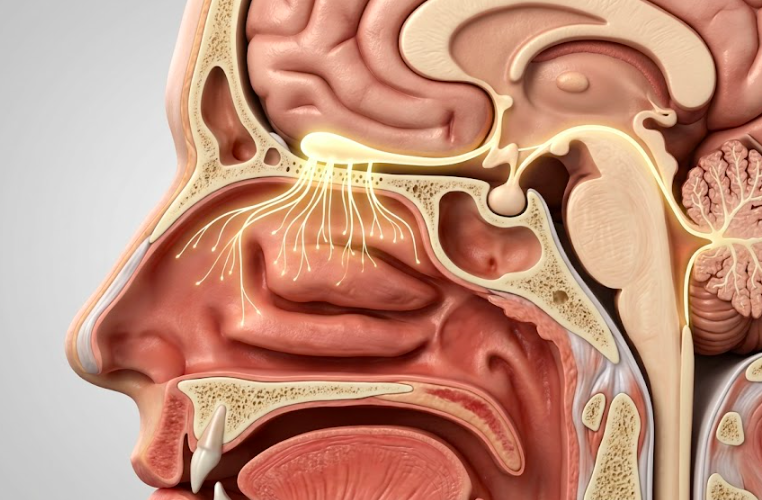
The Hong Kong team’s strategy with NanoPowder was to use an anatomical “shortcut”: the intranasal route.
The roof of the nasal cavity houses the olfactory epithelium. Unlike the rest of the body, in this region, olfactory neurons and branches of the trigeminal nerve cross the cribriform plate of the ethmoid bone, creating a direct, unmyelinated route from the external environment to the brain and cerebrospinal fluid (CSF), completely bypassing the Blood-Brain Barrier.
NanoPowder’s major asset lies in its nanotechnology formulation (a “nano-in-micron” system). Microscopic therapeutic particles are prepared into a dry powder that, when sprayed into the nasal cavity, adheres to the mucosa and travels through these neural pathways directly to the brain, delivering neuroprotective agents exactly where the ischemic damage is occurring.
Clinical impact: results and the future of basic life support
NanoPowder was not designed to dissolve the clot (that remains the function of thrombolytics or mechanical thrombectomy), but rather to “freeze” neuronal death and buy time.
In preclinical studies using animal models, applying the spray within 30 minutes of the ischemic event demonstrated an impressive reduction of over 80% in cerebral infarct volume. Besides preserving tissue, the treatment was associated with significant protection of global neurological and motor functions.
Although it is still in the preclinical phase and requires toxicological and human clinical trials to confirm safety and efficacy, the implications are revolutionary. If approved in the future, this device could rewrite Basic Life Support (BLS) and prehospital care protocols, allowing paramedics—or even instructed family members—to initiate brain rescue the exact moment motor weakness or aphasia is detected.
For us, as physicians and students, keeping up with the evolution of nanomedicine is fundamental. Stroke treatment is on the verge of evolving from merely a race against time to the CT scanner into an immediate cellular protection intervention.
About Educar Med
Educar Med isn’t just about passing tests; it’s about rejecting clinical mediocrity. We are a community dedicated to training the new generation of physicians who think, examine with precision, and transform lives.
Keep raising your clinical standards. Follow Educar Med on social media: