
In the era of medical hyper-automation, diagnoses are still failing for one unsettling reason: we have stopped truly observing the patient.
We are living at the pinnacle of the technological revolution in healthcare. Deep learning algorithms interpret MRIs with staggering accuracy, and Artificial Intelligence systems cross-reference thousands of biomarkers in fractions of a second. Everything seems to point toward a future of diagnostic infallibility. Yet, the clinical reality in emergency departments tells a different story. Patients continue to experience adverse outcomes not due to a lack of cutting-edge technology, but because of an alarming deficit in the fundamentals. By outsourcing clinical reasoning to screens, we are forgetting that the true map of the disease is imprinted on the body of the sufferer.
The danger does not lie in Artificial Intelligence, but in the cognitive dependency we are fostering. When an automated result conflicts with a patient’s complaint, the modern tendency is to blindly trust the software. It is precisely within this blind spot that diagnostic errors flourish.
Consider daily clinical practice. An elderly patient presents with extreme fatigue and dyspnea. The automated protocol is triggered: an AI-read chest X-ray, ECG, and cardiac markers. If the raw data lacks obvious consolidations or ST-segment elevations, the algorithm might suggest a “non-specific viral infection.” However, if a clinician simply pauses, observes jugular venous distention, and palpates congestive hepatomegaly, the diagnosis of decompensated heart failure is made right at the bedside. The machine did not process faulty data; it simply lacked the senses to evaluate what was not encoded.
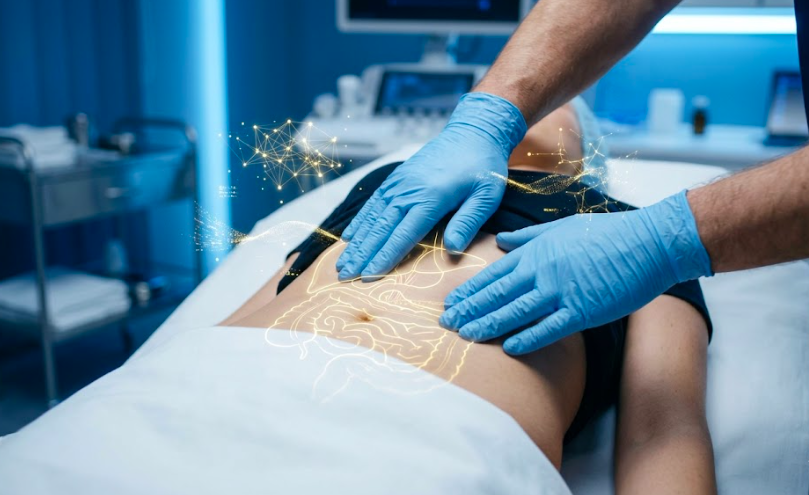
Similarly, a patient with weight loss and vague abdominal pain might receive a prescription for dyspepsia based on electronic health record prompts. Yet, a rigorous physical examination would reveal a Courvoisier-Terrier sign (a palpable, painless gallbladder) and subtle scleral icterus screaming the diagnosis of a periampullary neoplasm long before the system flags a warning.
The solution is not to reject technological advancement. Those who understand the architecture of AI know it is our greatest tactical ally: a cognitive exoskeleton capable of processing drug interactions and reducing bureaucratic load. However, semiology is not merely the technique of examining; it is the sophisticated human capacity to interpret biopsychosocial suffering. The scent of a patient’s breath, the texture of their skin, the hesitation in their voice these are inputs no algorithm can compute.
AI will never replace the clinical eye because processing data is fundamentally different from understanding pain. The future of elite medicine does not belong to machines, but to the professionals who master technology to reclaim their time and become profoundly human at the bedside once again.
About Educar Med
Educar Med isn’t just about passing tests; it’s about rejecting clinical mediocrity. We are a community dedicated to training the new generation of physicians who think, examine with precision, and transform lives.
Keep raising your clinical standards. Follow Educar Med on social media: