
I need to tell you something I learned the hard way: studying medicine isn’t enough to protect you from burnout. In fact, it’s probably a risk factor. I spent a semester thinking it was my own weakness. Difficulty concentrating on anything, a tiredness that sleep couldn’t fix, that strange feeling of looking at a clinical case and feeling nothing, no curiosity, no distress, nothing. Just indifference. When I was researching for a humanization seminar, I came across the criteria for burnout and had that uncomfortable feeling of recognition. So I decided to truly understand what this is, not what goes around in self-help posts, but what the literature actually says. This text is the result of that.
What burnout really is (and what it isn’t)
Burnout isn’t just being tired. It’s not that finals week exhaustion that goes away over the weekend. It is an occupational syndrome, officially recognized by the WHO in the ICD-11, resulting from chronic workplace stress (or study stress, which for us is the workplace) that has not been successfully managed.
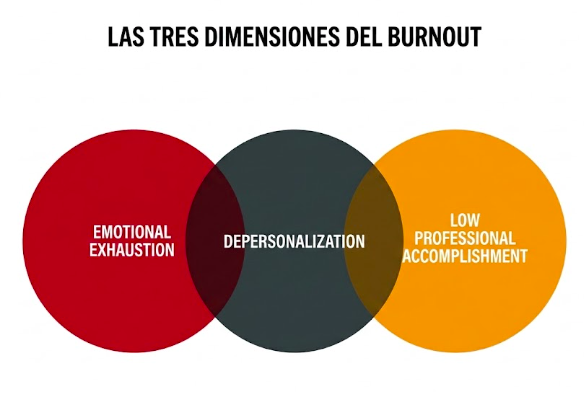
The most widely used model in the literature is Maslach’s, which describes burnout in three dimensions:
- Emotional exhaustion: you no longer have the emotional energy to cope with what you need to do. It’s not laziness, it’s truly running on empty.
- Depersonalization: a kind of emotional anesthesia. You start treating situations (and sometimes people) in a distant, cynical, almost mechanical way. This is very frightening when it happens in medicine, because it goes against everything we came here to do.
- Low professional accomplishment: the feeling that what you do has no meaning or value. That you are not competent. That it’s pointless.
It is important to say: burnout is not depression, but it can coexist with it. It’s not anxiety, but it can feed it. It is a syndrome with its own characteristics, specifically related to the work or study context.
Why medicine is such a breeding ground for it
It’s no coincidence that studies show an extremely high prevalence of burnout among medical students and residents. There is a specific combination of factors that creates almost perfect conditions for the syndrome to take hold:
- The culture of endurance: There’s a deeply rooted myth in medicine that suffering is part of the process. “I went through it, you will too.” The amount of hours spent awake becomes almost a badge of honor. Asking for help is seen as a lack of preparation. Showing vulnerability, as weakness. This creates an environment where warning signs are constantly minimized by outsiders and, more dangerously, by yourself.
- Real and prolonged overload: Medicine is not a 40-hour-a-week major. It’s clinical rotations, call shifts, studying, seminars, reports, exams, patient care. And this isn’t a complaint, it’s just the reality of the curriculum. The problem is when this workload has neither an escape valve nor acknowledgment.
- Constant exposure to high emotional impact situations: We deal with pain, death, bad diagnoses, and desperate families early on in our clinical rotations. Without specific training to emotionally process these situations. Without institutional space for it. Often, without even having time to breathe between one patient and the next.
- Imposter syndrome: The feeling that you know nothing, that everyone around you knows more, that you shouldn’t be there, it’s almost universal in medicine and directly linked to burnout. It increases self-criticism, reduces satisfaction with your achievements, and fuels the cycle of exhaustion.
Signs that medical students often ignore
These are the signs that appear in the literature and that I personally have seen (and felt) being swept under the rug:
- Tiredness that doesn’t go away with rest (you sleep 8 hours and wake up exhausted).
- Difficulty concentrating on things that used to be easy.
- Loss of interest in things that used to motivate you, even outside of medicine.
- Irritability outside your normal pattern.
- A feeling of emotional anesthesia towards cases that should move you.
- Thoughts like “I don’t see the point in this” or “the outcome doesn’t matter.”
- Isolation (decreased contact with close friends and family).
- Physical symptoms with no organic cause: frequent headaches, abdominal pain, insomnia.
An isolated sign isn’t a diagnosis for anything. But several together, for weeks, deserve attention.
What the evidence shows actually helps
Before listing the things that work, I need to be honest: there is no simple solution. Burnout is a problem that has an individual component but also a structural one, and medicine, as an institution, still responds very poorly to this second part. That being said, here is what the literature supports as a useful intervention at the individual level:
- Psychotherapy (especially CBT and third-wave therapies): Cognitive Behavioral Therapy has solid evidence for managing stress and burnout. Therapies like ACT (Acceptance and Commitment Therapy) also show consistent results in healthcare populations. It’s not a luxury, it’s a tool.
- Real separation between study and rest: The problem isn’t resting too little, it’s not being able to disconnect when you do rest. A brain stuck in a “constant draft of guilt” mode doesn’t process rest properly. Setting time limits, even if strict at first, helps to recalibrate.
- Regular physical movement: Physical exercise has an effect on cortisol, serotonin, and brain plasticity that is well documented. You don’t need to go to the gym every day, but doing something, regularly, changes the biochemistry of stress.
- Intentional social connections: Burnout pushes you towards isolation, and isolation worsens burnout. Actively maintaining contact with people outside the medical environment — or even inside, but in non-academic contexts, is protective.
- Knowing when to ask for professional help: If the symptoms are persistent, if they are affecting your ability to function, if you are having thoughts of self-harm or thoughts of giving up, that is the time to seek specialized help. Not after finals. Now!
One thing medical school rarely tells you
Medicine will continue to be hard. Clinicals will be exhausting. Residency will test you a lot. This isn’t pessimism, it’s a reality you probably already know. But there is a difference between real difficulty and avoidable suffering. Between the legitimate tiredness of someone doing their best and the pathological exhaustion of someone who received no support at all.
Medicine needs people who can care for patients for decades, with presence and competence. And for that, it needs professionals who take care of themselves. Not as a corporate wellness slogan, but as a condition for sustainability. If you are reading this post and recognized yourself in any of this, that isn’t weakness. It’s a fact.
References
- Maslach C, Leiter MP. Understanding the burnout experience: recent research and its implications for psychiatry. World Psychiatry. 2016;15(2):103–11.
- World Health Organization. ICD-11: International Classification of Diseases, 11th Revision.