
Neurology has always taught us a hard lesson: the central nervous system (CNS) does not regenerate. Unlike skin or bone, a spinal cord injury traditionally signifies permanent damage. This is why any news regarding a “cure” for paraplegic or tetraplegic patients spreads like wildfire.
Recently, the internet was flooded with reports of a revolutionary substance capable of restoring movement to patients with spinal cord injuries: Polylaminin. However, as medical students and future physicians, we must read the headlines through the lens of clinical reasoning and evidence-based medicine.
What is Polylaminin and the mind behind It
The greatest pride of this discovery is that it was born in Brazil. Dr. Tatiana Sampaio, a neuroscientist at the Federal University of Rio de Janeiro (UFRJ), dedicated over 25 years to this research.
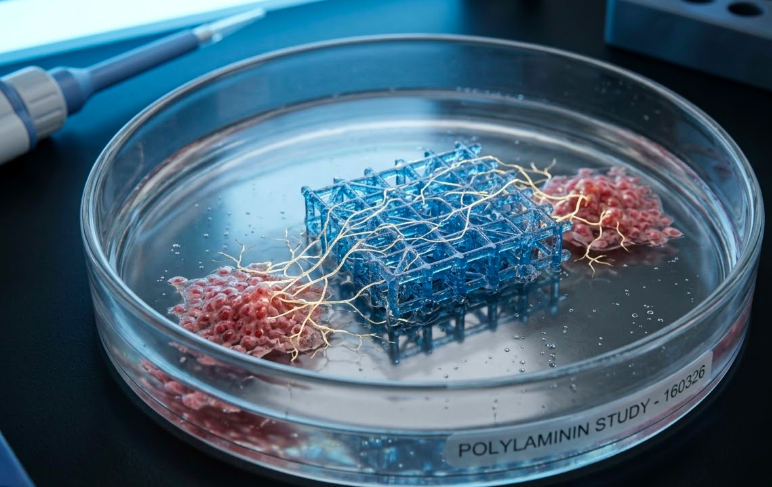
The major problem with spinal cord injuries is that, following the trauma, an impenetrable scar forms, preventing neurons from reconnecting. Dr. Sampaio’s genius lay in developing Polylaminin as a sort of “biological scaffold.” This substance acts as a bridge, guiding ruptured axons to regrow across the injured area, thereby restoring nerve communication.
Clinical reasoning: separating hope from sensationalism
This is where the Educar Med method comes into play. When a patient in the clinic asks us about “the new injection that makes you walk,” we cannot be guided solely by the emotion of viral videos.
Science does not perform miracles overnight, it follows a method.
- Experimental Phase: Despite promising and impressive results, the therapy remains experimental.
- Clinical Trials: Anvisa (the Brazilian Health Regulatory Agency) recently authorized the start of Phase 1 clinical trials. The goal of this phase is not to prove large-scale efficacy, but to ensure the safety of the substance in humans.
The role of the future physician
The discovery of Polylaminin is a historical milestone. It shows us that the “impossible” in medicine is simply something that has not yet had enough research. Nevertheless, our responsibility in the office is to embrace the patient’s hope without fueling false promises, explaining the stages of the scientific method in a didactic manner.
Brazilian science is doing its part in the lab. We must do ours in the clinic.
About Educar Med
Educar Med isn’t just about passing tests; it’s about rejecting clinical mediocrity. We are a community dedicated to training the new generation of physicians who think, examine with precision, and transform lives.
Keep raising your clinical standards. Follow Educar Med on social media: