
The recent media attention surrounding the health scare of socialite Kim Kardashian, diagnosed with acute esophagitis following a hospital admission, sparked widespread public concern due to memories of her late father, Robert Kardashian Sr., who passed away from esophageal adenocarcinoma. Although this case made entertainment headlines, for the academic and medical community, it serves as an excellent starting point to review crucial concepts in clinical gastroenterology and propaedeutics.
Below is a detailed breakdown of what every medical student must master regarding differential diagnosis, etiologies, and the screening of esophageal lesions.
1. Medical Introduction of the Case: The Fine Line Between Inflammation and Neoplasia
In daily clinical practice, acute esophageal symptoms (such as odynophagia, intense heartburn, and retrosternal chest pain) frequently mimic serious conditions or cause considerable patient anxiety, amplified by a family history of malignancies.
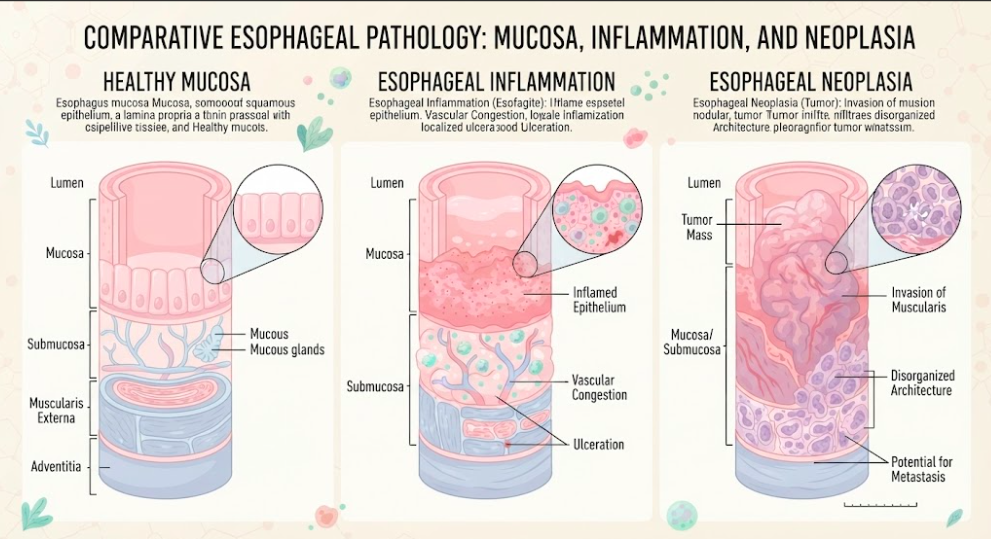
This high-profile case perfectly illustrates the distress caused by symptom overlap between benign inflammatory pathologies (esophagitis) and upper gastrointestinal malignancies. Knowing how to conduct a semiological investigation and reassure the patient based on scientific evidence is a fundamental role for the physician.
2. Definition and Etiology of Esophagitis
Esophagitis is defined as any inflammatory injury to the esophageal mucosa. Clinically, it is classified into distinct etiologies that require separate diagnostic reasoning:
- Peptic Esophagitis (GERD): The most common cause, resulting from chronic exposure of the esophageal squamous epithelium to gastric acid and pepsin due to incompetence of the lower esophageal sphincter (LES).
- Infectious Esophagitis: More prevalent in immunocompromised patients (such as those with HIV, undergoing chemotherapy, or on corticosteroid therapy). Key pathogens include:
- Candida albicans (creamy white plaques seen on upper endoscopy).
- Cytomegalovirus (CMV) (deep, linear ulcers).
- Herpes Simplex Virus (HSV) (shallow, punctate ulcers).
- Eosinophilic Esophagitis: A chronic, immune-mediated inflammatory disease with a strong allergic/atopic component, characterized by an eosinophilic infiltrate of ≥ 15 eosinophils per high-power field on biopsy.
- Medication-Induced Esophagitis: Direct caustic injury caused by drugs retained in the esophagus (e.g., bisphosphonates, NSAIDs, tetracyclines, potassium chloride) due to inadequate water intake or immediate post-pill recumbency.
3. The Spectrum of Esophageal Cancer (The Legacy of Robert Kardashian)
Esophageal cancer is an aggressive malignancy, frequently diagnosed at advanced stages. In oncological propaedeutics, two major histological subtypes with distinct epidemiological profiles stand out:
- Adenocarcinoma: Typically associated with chronic gastroesophageal reflux disease (GERD) and the complication known as Barrett’s Esophagus (intestinal metaplasia of the esophageal epithelium). It has a higher incidence in the distal third of the esophagus.
- Squamous Cell Carcinoma: Traditionally associated with classic risk factors: smoking and alcohol consumption. It is most frequently located in the middle and proximal thirds of the esophagus.
The Importance of Screening and Alarm Symptoms
Any patient presenting with alarm symptoms must undergo immediate endoscopic investigation. Warning signs include:
- Progressive dysphagia (initially for solids, then for liquids).
- Unintentional weight loss (unexplained emaciation).
- Persistent odynophagia.
- Upper gastrointestinal bleeding (hematemesis or melena).
- Unexplained iron deficiency anemia in high-risk age groups.
4. Diagnostic Approach and Management in Gastroenterology
To accurately differentiate inflammatory disorders from malignancies, instrumental propedeutics relies on essential tools:
- Upper Gastrointestinal Endoscopy (EGD) with Biopsy: This is the gold standard. It allows direct visualization of the mucosa, grading of esophagitis severity (e.g., Los Angeles Classification), and collection of tissue fragments for histopathological study, essential to rule out dysplasia and carcinomas, as well as to identify infectious agents or tissue eosinophilia.
- High-Resolution Esophageal Manometry: Indicated for evaluating esophageal motility disorders (such as achalasia or diffuse spasms) when EGD rules out severe obstructive or inflammatory organic lesions.
- 24-Hour Esophageal pH-Impedance Monitoring: Fundamental in cases of refractory GERD or for symptom correlation with acid and non-acid reflux episodes.
💡 Elevate Your Studies in Gastroenterology and Internal Medicine!
Master digestive propedeutics, learn to interpret imaging exams, and cut down on inefficient rote memorization during your clinical rotation in medical school.
- 📚 Discover our advanced materials and high-retention flashcards at educarmed.com — Created by students to optimize your reviews for exams and hospital shifts!