
Have you ever felt your heart race when the attending turns to you and asks: “So, what do we have in bed 4?”
If your immediate response is to frantically start reading from your notebook, dumping an avalanche of disconnected lab data, take a deep breath. You are not alone. Medical school teaches us how to take a gigantic history, but it rarely teaches us how to synthesize and reason out loud.
Presenting a clinical case isn’t just reading the patient’s history. It is proving to your attending (and to yourself) that you know how to think like a physician. It is taking scattered puzzle pieces and handing over the completed picture.
In this article, you will learn the definitive structure to present clinical cases with clarity, confidence, and razor-sharp clinical reasoning.
The Biggest Mistake: The “Data Dump”
The most common mistake students make on the wards and in the clinics is the Data Dump. This is when you report every single irrelevant detail the patient mentioned, from what they had for breakfast to the toe pain they had 10 years ago, hoping the attending will fish out the diagnosis from the mess.
A confident doctor doesn’t just report facts; they build a clinical narrative. Every sentence of your presentation should guide the listener toward your diagnostic hypothesis.
The Golden Structure: The 3-Minute Summary
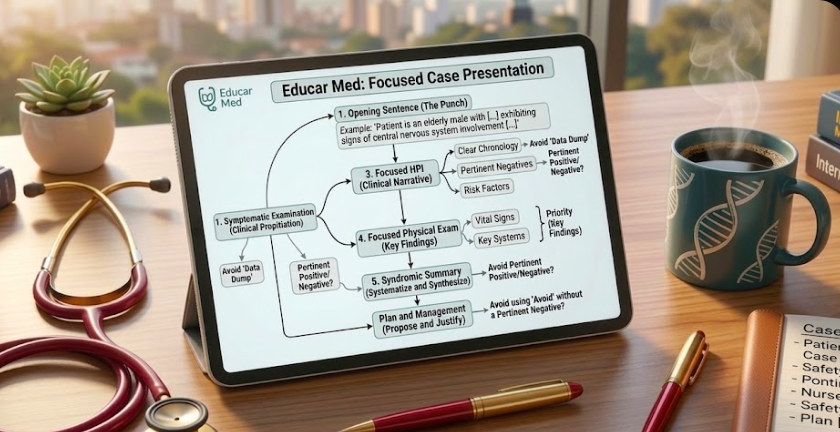
To be heard and respected, your presentation must be surgical. Follow this 5-step structure:
1. The Opening Statement (The “Punch”) In the first 15 seconds, the attending needs to know what they are dealing with. Don’t start with “The patient is John…”. Start with the essence:
- Incorrect: “This is Mr. John, 65 years old, who came in last night complaining of shortness of breath.”
- Correct: “This is Mr. John, a 65-year-old male with a history of hypertension and smoking, who presents with acute dyspnea on mild exertion and lower extremity edema for the past 3 days.”
2. The Targeted History of Present Illness (HPI) Forget the rigid script. Report the chronology of the main symptoms and add only the risk factors and associated symptoms (or the lack thereof, the famous “pertinent negatives”) that confirm or rule out your top hypotheses. If you suspect Heart Failure, the fact that he does not have a fever or productive cough is a crucial piece of data to rule out pneumonia.
3. The Focused Physical Exam Do not recite the entire normal physical exam. Go straight to the vital signs and the positive (and negative) findings that matter for that chief complaint.
- Example: “Vital signs are stable, except for tachypnea. Physical exam is notable for jugular venous distention at 45 degrees and bilateral basilar crackles. No murmurs.”
4. The Holy Grail: The Syndromic Summary (Problem Representation) This is where you separate the student who memorizes textbooks from the student who has true Clinical Reasoning. Synthesize the case into a syndrome before giving the final diagnosis.
- The Synthesis: “In summary, this is an elderly patient with high cardiovascular risk presenting with an acute Pulmonary and Systemic Congestive Syndrome.”
5. The Plan (Act Like the Doctor) Never finish the presentation and just stare at the attending waiting for the answer. Take the stance of someone who is leading the case. Give your primary hypothesis, two differential diagnoses, and propose the initial management.
Practice makes perfect
Presenting clinical cases is a motor and mental skill. It requires repetition. Before you stand in front of the chief of the ward, practice in the mirror, practice with the resident, practice mentally in the hallway.
To help you accelerate the mental organization of your summaries, mastering artificial intelligence tools can be a game-changer in your case studies. Be sure to download our e-book “AI Prompts for Medical Students” to learn how to create clinical case simulations and refine your reasoning with the help of technology. The link is available right here on the site!
Remember: the goal is not to always have all the right answers, but to demonstrate that you have a logical, structured, and confident path to reach them.
About Educar Med
Educar Med isn’t just about passing tests; it’s about rejecting clinical mediocrity. We are a community dedicated to training the new generation of physicians who think, examine with precision, and transform lives.
Keep raising your clinical standards. Follow Educar Med on social media: